
Embarking on a cross-country journey in an aged yet reliable Tesla Model 3, Arthur Frederick Hasler sets his sights on South Dakota, a state rich in both natural beauty and renewable energies. This voyage, spanning 1,535 miles from Lindon, Utah to Three Lakes, Wisconsin, underscores the seamless integration of modern electric vehicles in a landscape dominated by both cutting-edge and traditional energy sources.
South Dakota, celebrated for its extensive scenic wonders, gains a pivotal role in Arthur’s route. As he traverses through this midwestern gem, the influence of clean energy is palpable. Numerous wind turbines punctuate the landscape, silently generating renewable energy and standing as testaments to the state’s commitment to a greener future.
Despite the challenges of range degradation over the years—his Tesla model initially boasted an EPA-rated 310 miles, now reduced to about 243—Arthur remains undaunted. The car’s mileage, standing at an impressive 175,359, might suggest weariness, yet its dual-motor strength propels him forward. South Dakota’s network of Superchargers, though sparse compared to other more populous regions, plays a critical role in sustaining his travel momentum, highlighting the state’s gradual adaptation to evolving transportation demands.
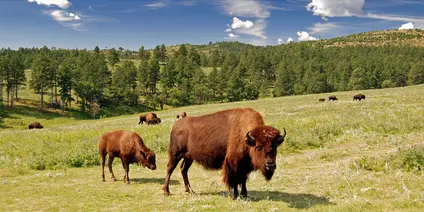
Custer State Park
During the journey, a notable pause brings Arthur to Custer State Park, located in Southern Black Hills, renowned for its population of bison and friendly wild donkeys. South Dakota’s pride in its wildlife and conservation efforts shine through at this sanctuary, providing visitors with direct, breathtaking interactions with the state’s fauna.
Likewise, Bear Country USA near Rapid City extends an invitation to marvel at the raw, untamed beauty of grizzly bears. Here, vehicles crawl through expansive enclosures as occupants witness the majesty of these great creatures at a relaxed pace, a luxury not offered by zooming past plains.
South Dakota, while strongly embracing renewable energies—apparent from the wind turbines—is no stranger to more traditional power sources. The juxtaposition is stark, with regions such as Wyoming neighboring to South Dakota’s west, famous for its coal deposits, alongside South Dakota’s own emphasis on conserving natural habitats.
As Arthur charges his Tesla at strategic intervals, the significance of Superchargers in less-populated areas becomes apparent. While cities like Worthington, Minnesota have seen the introduction of new V3 Superchargers to ease travel, Arthur’s route reveals the necessity of expanded infrastructure for a fully realized electric car ecosystem. Nowhere does this need become clearer than along the stretches of South Dakota highways where the miles between charges can be long, thus indicating room for growth in state’s EV adoption strategy.
Throughout this scenic yet modern pilgrimage, one cannot overlook South Dakota’s hallmark attractions, like the famous roadside icons Wall Drug and the nearby Little America. Their signs act as whimsical markers of progress along the journey, blending nostalgia with modern electric mobility.
The role of South Dakota in this green highway story signifies more than crossing state lines; it represents the harmonization of progress with tradition, of wild prairies with wind turbines, and of the ancient with the electro-modern. As more travelers traverse its byways in vehicles like the aging Tesla, the state’s contributions to sustainable travel become ever more pronounced.
Through this test of mileages and Supercharger logistics, Arthur Hasler’s expedition reaffirms the viability of long-distance EV travel even in regions where infrastructure is still catching up. South Dakota with its natural wonders, renewable initiatives, and modern challenges remains a resolute waypoint in the journey toward sustainable transportation.
For any further inquiries or insights into electric travel through South Dakota, feel free to reach out via info@sodak.news.