
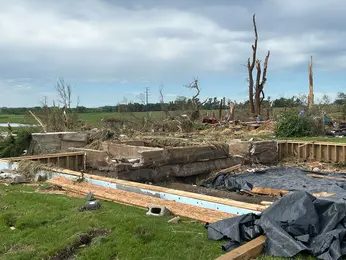
On June 29, 2025, the serene landscapes of South Dakota were abruptly transformed as a powerful tornado swept through Deuel County, leaving behind a trail of devastation. Among the casualties was a historic farmhouse, whose exposed foundation now stands as a stark reminder of nature’s fury. This natural disaster highlights the vulnerability of South Dakota’s rural heritage but also showcases the resilience and community spirit inherent in its people.
NWS Aberdeen, South Dakota
This image, captured by NOAA/NWS Aberdeen, represents a significant moment for the residents of Deuel County and for South Dakota as a whole. The farmhouse, once a symbol of stability and family heritage, was swept away, leaving only its foundation. It was a poignant reminder of the power of nature and the unpredictability faced by those living in tornado-prone regions.
The heart of this story lies not just in the destruction, but in the community’s response. South Dakota, known for its close-knit communities, saw neighbors helping each other in the aftermath. Volunteers from nearby towns flocked to Deuel County, providing aid and comfort to those affected. This spirit of solidarity has long defined the people of South Dakota, who are accustomed to facing challenges with resilience and mutual support.
South Dakota’s landscape, characterized by expansive plains and breathtaking sunsets, embodies a rich agricultural tradition. However, its geographical location also makes it susceptible to severe weather patterns, including tornadoes, which are a common occurrence in the upper Midwest. The local government, along with NOAA and NWS, work tirelessly to provide timely warnings and ensure public safety. In this instance, their efforts helped minimize casualties.

NOAA
This event also underscores the importance of preserving historical structures that represent South Dakota’s rural heritage. The lost farmhouse was more than just a building; it was a testament to the state’s pioneer past and the families who have farmed these lands for generations. With the increasing frequency of extreme weather events, there is a growing call to invest in strengthening infrastructure to withstand future storms while maintaining the historical integrity of these structures.
The loss serves as a catalyst for discussions on sustainable building practices, community resilience, and the balance between preserving history and ensuring safety. South Dakotans are increasingly looking toward innovative solutions to protect their homes and landmarks, including advanced storm-resistant designs and community education on disaster preparedness.
Amidst the challenges, there is a silver lining in the form of increased awareness and preparedness. Local educational campaigns, supported by NOAA, aim to equip communities with the knowledge and resources needed to respond effectively to such emergencies. This proactive approach is essential in a state where agriculture is not only a livelihood but a way of life.
In conclusion, the story of the farmhouse in Deuel County is a microcosm of the broader challenges and triumphs faced by South Dakota. It highlights the delicate balance between tradition and innovation, the power of community, and the relentless spirit of a state that stands resilient against adversity.