
By [Author Name]
South Dakota’s enchanting landscapes, notably the Black Hills, have long been a nexus of natural beauty and environmental debate. Recently, these discussions have gained renewed attention through the award-winning work of Anna Van Kley, a passionate historian specializing in the development of public preservation projects in this region.
The prestigious nomination—another feather in the cap for the University of South Dakota—came from Dr. Molly Rozum, a distinguished associate professor in the Department of History. Rozum lauded Van Kley’s thesis for its accessible, engaging approach and its thorough exploration of early 20th-century conservation and preservation debates. “Her stories add up to a spectrum of wilderness thought that enhance and complicate what history records about early 20th century conservation and preservation,” Rozum remarked.
Enlightening Historical Perspectives on South Dakota Land Preservation
Van Kley’s research shines a spotlight on key public preservation projects within the Black Hills, such as Wind Cave National Park, Custer State Park, and the iconic Mount Rushmore National Memorial. Her work delves into how various groups perceived these lands and what drove them to protect these territories from industrial encroachment. “These South Dakota parks were established during national debates about the intrinsic and extrinsic value of protecting lands for the public,” Van Kley noted, emphasizing how local attitudes and actions were shaped by larger discourses of American nationalism, gender, colonialism, and commercial development.
A Heartfelt Origin Story
Though her current work is steeped in the history of the Black Hills, Van Kley’s journey began far off in Columbus, Georgia, where her childhood was imbued with a love for historic places and national parks. Recollecting vacations spent exploring museums and landmarks ignited her lifelong interest in history and environmental studies.
Her path led her to Berry College in Rome, Georgia, where she pursued a dual major in history and sociology. Here, Van Kley’s intrigue with national parks deepened, inspiring her to work with the National Park Service as an interpretive park ranger, an experience that enriched her understanding of park historical narratives.
The Academic Bridges at USD
Van Kley credits her accomplishments to the robust support network at the University of South Dakota (USD). It was here that she not only received a teaching assistantship, scholarship, and research grant but also found invaluable mentorship from faculty like Dr. Rozum. “She knew about books that I could read to begin my research project and always had ideas about new avenues for research throughout the revision process,” Van Kley expressed with gratitude.
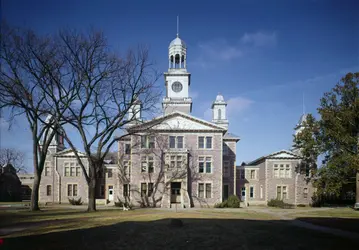
University of South Dakota
With this academic foundation, Van Kley explored how the Black Hills emerged as focal points of preservation ideology, given the sheer number of parks established there in short succession. This regional dedication to conservation has, in many ways, influenced the continued discourse on conservation policies nationally.
The Journey Continues: Awards and Future Possibilities
Recognition for Van Kley’s thesis did not stop at USD. She made history as the first USD student to be acknowledged at the Midwestern Association of Graduate Schools/ProQuest Distinguished Master’s Thesis Award in Humanities, securing the first runner-up position in this prestigious conference held in Kansas City, Missouri. This accolade comes as no surprise to those familiar with her work, which blends rigorous research with a deep commitment to environmental advocacy.
Currently serving as a museum educator at the National Music Museum, Van Kley continues to resonate with her award’s recognition, considering it a powerful affirmation of the potential impacts her scholarship can have. She revealed ongoing plans to publish an article based on her thesis, and quietly ponders the pursuit of a doctorate in history.
Expanding the Narrative: The Importance of the Black Hills in Environmental Scholarship
Van Kley remains hopeful that her work will inspire a deeper appreciation of South Dakota’s parks in the wider context of environmental debates. “Many historical studies about public parks focus on ‘crown jewel’ parks,” she explained. “The Black Hills deserve more recognition as the debates about preservation and conservation didn’t end when those parks were established. They represent and complicate the ongoing discussions about preservation and conservation, which are vital to the overall scholarship of environmental history.”
As South Dakota continues to forge its environmental narrative, one can only anticipate further advancements and scholarship emerging from its vibrant academic community, driven by inspirational thinkers like Anna Van Kley.