
RAPID CITY, SD — South Dakota, a region celebrated for its majestic landscapes and vibrant communities, faces an increasing threat from wildfires exacerbated by climatic variations. Behind the scenes, a concerted effort is underway to enhance wildfire forecasting methods to safeguard its richly forested territories, particularly the Black Hills. Central to this mission is Gavin Bird, an atmospheric and environmental sciences scholar from the South Dakota School of Mines and Technology. This summer, Bird has embarked on a pivotal internship with South Dakota Wildland Fire, focusing on innovations in wildfire forecasting.
The summer of 2026 has been increasingly warm, with temperatures reaching triple digits in parts of western South Dakota. The escalating heatwave poses significant challenges for firefighting authorities tasked with safeguarding communities. Bird’s work at the Weather Lab, under the mentorship of Dr. Darren Clabo—a revered associate professor of practice and state fire meteorologist—focuses on predicting and understanding these critical weather patterns to support firefighting operations.
The Role of Weather Forecasting in Firefighting
“The weather directly dictates how a wildfire moves across a landscape,” says Dr. Clabo. “Fire managers need to know what the weather is going to do so they can better prepare for potential wildfires, and so they can best direct suppression resources if a wildfire has already started.” For Bird, these insights form the bedrock of his work, offering firsthand experience in a domain that blends applied science with community service.
Within his internship, Bird delves into the nuances of how strategic, weather-informed firefighting commands are executed. His journey so far has seen him accompany Dr. Clabo on field expeditions inspecting grass and soil conditions crucial for fire modeling. The dynamic environment of the Weather Lab allows Bird to test emerging theories and methodologies concerning fire behavior and weather predictability across the Black Hills.
Bird’s training program further includes practical immersion, training to be a certified wildland firefighter. This practical aspect was vividly evident when Bird participated in a live-fire exercise at Custer State Park. “I got to tie in with a couple of hand crews down there, dig some [fire] line, and play with live fire,” he recounts, recognizing the value of these hands-on experiences in understanding the operational challenges faced by firefighters.
Exploring Snow-Depth Trends in South Dakota
South Dakota exhibits a predominant reliance on prescribed burning during the cold months to manage forest fuels in the Black Hills—a vital tactic in preventing summer wildfires. However, Bird’s internship has also involved significant research into the region’s long-term snow-depth trends. These trends, as his research indicates, show a concerning decline, posing substantial implications for the timing and feasibility of prescribed burns.
“Cold-season prescribed fire is a leading tool we have to manage fuels in the Black Hills,” Dr. Clabo explains. “If we have a better idea of how snow depth has changed over time, we can better inform policymakers about what the future may bring. This directly impacts how we manage the wildfire fuels.” Bird’s research suggests that fluctuating winter conditions necessitate innovative adaptations in wildfire management practices, which are critical for South Dakota’s long-term ecological health.
Aviation and Wildfire: Bridging Interests
Bird’s passion for combining his interest in weather, wildfire, and aviation has also been ignited through distinct experiences such as visiting the Rapid City Airtanker Base, where aerial firefighting operations are coordinated. Watching airborne crews in action has been a highlight for Bird, solidifying his aspiration to meld aviation technology with meteorological forecasting after graduation. “Whether that’s working for the National Weather Service or for a private airline or something, that would be great,” Bird articulates, envisioning a seamless fusion of his interests.
Ultimately, Bird’s internship serves as both a nexus for his multiple interests and a cornerstone for South Dakota’s ongoing efforts to fortify its approach to wildfire management. As he progresses, Bird exemplifies a new generation of meteorologists poised to utilize scientific insights in practical, community-focused applications—vital for regions like South Dakota where the balance between nature’s splendor and its perils hinges on informed, decisive action.
Acquiring this dual knowledge of firefighting and forensic weather science is in alignment with South Dakota Mines’ dedication to advancing educational stewardship that directly contributes to community and environmental resilience throughout the state.
In South Dakota’s varied landscape, from its thriving communities to the rugged terrains of the Black Hills, the work undertaken by students like Bird ensures that the natural beauty and safety of the region are preserved for generations to come.
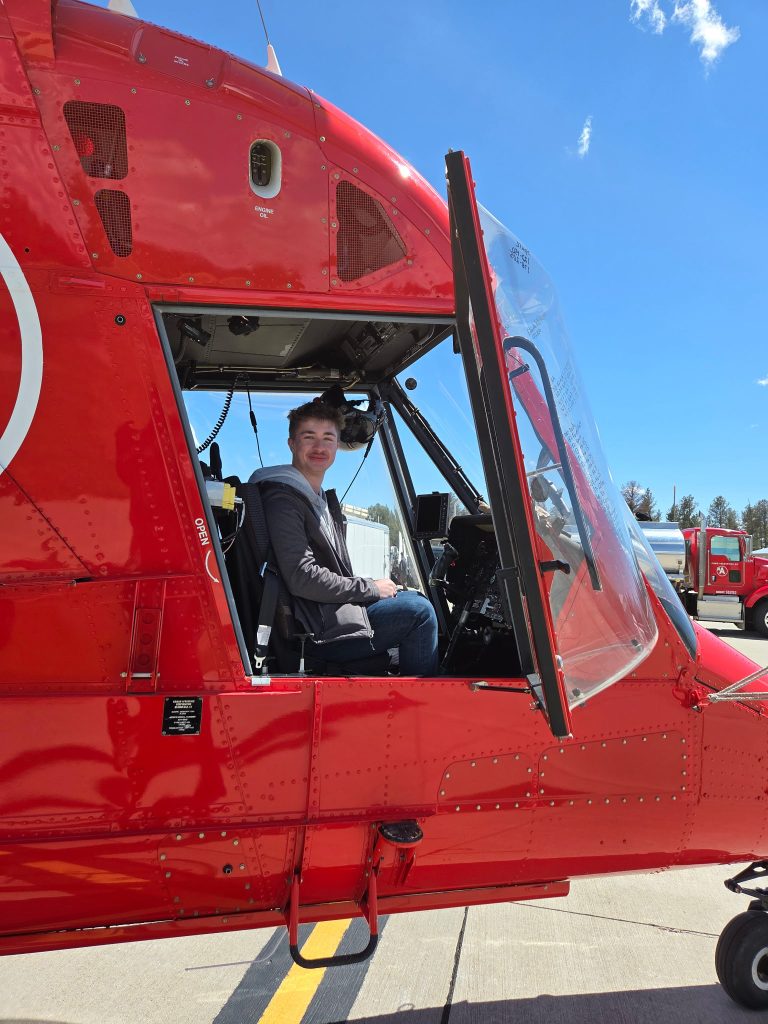
Gavin Bird, a South Dakota Mines atmospheric and environmental sciences student, in a K-MAX helicopter at the Black Hills Helitack base in Custer.
Dr. Darren Clabo, associate professor of practice and state fire meteorologist, mentoring Bird at the Weather Lab.